Choosing a China Best Leather Sparring Boxing Headguard Supplier requires more than comparing prices. A reliable partner must understand impact protection, fit, material behavior, and repeat manufacturing control. The Leather Sparring Boxing Headguard should feel secure without restricting vision or breathing. Its leather shell needs even stitching, reinforced seams, and consistent padding around the forehead, cheeks, and jaw.
Safety comes first.
Industry data supports this careful approach. Grand View Research reports continued growth in global combat sports equipment demand, driven by fitness participation, boxing clubs, and structured training programs. Research and Markets also identifies product durability, customization, and protective performance as important purchasing factors. These reports describe market direction, not proof of product quality. That distinction matters.
A professional supplier should provide material specifications, size charts, production photos, inspection records, and clear sample procedures. Buyers should examine leather thickness, foam recovery, hook-and-loop strength, sweat resistance, and stitching density. A practical test includes repeated pad work, head movement, and cleaning after use. Small defects become obvious then.
No supplier is perfect.
Claims such as “best” need evidence, not slogans. ISO 9001 certification can indicate process management, but it does not replace product testing or user evaluation. Experienced manufacturers should also explain customization limits, packaging protection, lead times, and after-sales handling. For gyms, coaches, distributors, and private-label brands, transparent communication builds safer and more reliable purchasing decisions.
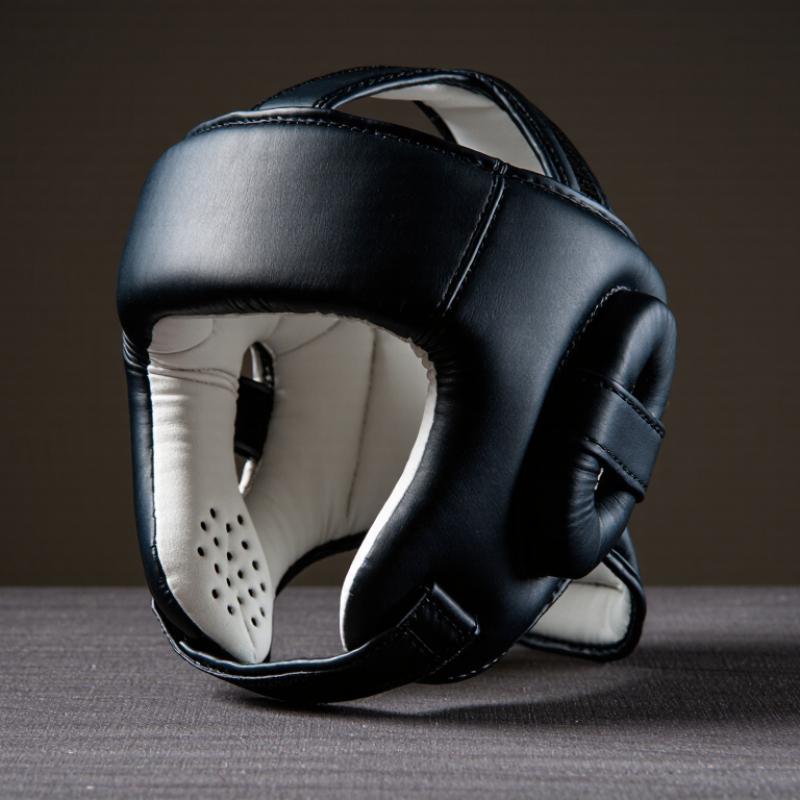
China Best Leather Sparring Boxing Headguard Supplier
Choosing a leather boxing headguard requires more than checking appearance. Full-grain leather offers strong fibers and develops a natural patina. Top-grain leather feels smoother and can provide consistent surface quality. Split leather costs less, but its finish and durability depend heavily on treatment. Thickness alone proves little. Stitch density, foam recovery, edge binding, and moisture control also deserve inspection.
Fit controls protection during real sparring. The guard should sit above the eyebrows without blocking vision. Ear coverage must remain stable when the wearer turns quickly. A rear hook-and-loop adjustment can reduce movement, but excessive tightening creates pressure points. Check the cheek area, chin clearance, and nose space with a mouthguard fitted. Try it with boxing gloves. Small details matter.
EN 13277-4 addresses protective headgear requirements and test methods for martial arts equipment. A responsible supplier should identify the tested model, size range, materials, and laboratory documentation. Ask whether the report matches the current product, not merely a similar sample. Impact attenuation, coverage, retention, and visual access should be reviewed together. In my experience, attractive leather often hides uneven padding. That is easy to miss. A practical inspection may reveal loose seams or compressed foam after repeated use. No supplier should treat a certificate as a substitute for careful fitting, batch control, and honest product records.
Leather construction needs measurable control, not attractive descriptions. Leather Naturally’s Leather Facts technical brief notes that thickness changes across a hide, especially near the shoulder and belly.
For sparring headguards, buyers commonly request 1.0–1.4 mm finished leather, then verify five points per panel. One reading is not enough. ISO 3377-2:2016 provides a recognized method for measuring leather tear strength. I would also record grain damage, stretch, and moisture before production.
Foam density affects cushioning and shape retention. ASTM D3574 remains a widely used reference for flexible polyurethane foam testing, including density and compression behavior.
A practical purchasing range is often 45–80 kg/m³ for protective foam, depending on layer design. However, density alone can mislead. Two foams may weigh the same but compress differently.
Test thickness loss after repeated compression, not only a laboratory sample. Seam strength deserves equal attention. Use a fixed stitch length, reinforced stress zones, and tensile testing on complete seam sections.
Internal acceptance limits, such as 150–250 N, should be validated with real usage trials.
Tips: Ask for a material batch record, foam test report, and seam photographs. Check corners, ear openings, and chin straps first. Small defects appear there. Do not trust “premium leather” without measurements. Inspect ten finished units, because one perfect sample proves very little. Reconsider any supplier that provides density data without test conditions or specimen thickness.
China Best Leather Sparring Boxing Headguard Supplier
A dependable leather sparring headguard supplier should treat EN 13277-4 testing as a design process, not a paperwork exercise. Impact testing measures how well the headguard reduces transmitted force during controlled strikes. Test technicians inspect the shell, padding, seams, and contact points. Small changes in foam density can alter results.
Coverage matters just as much. The headguard should protect the forehead, cheeks, ears, and rear head area without blocking safe vision. Technicians check exposed zones with prescribed measurements and practical fitting checks. A good sample should remain stable on different head shapes. It should not press painfully against the jaw.
Retention testing examines whether the guard stays in place during movement and impact. Straps, hook-and-loop closures, and chin protection require careful adjustment. Too loose is unsafe. Too tight can discourage regular use. Prototype testing often reveals this compromise. We have seen straps pass a static check yet shift during repeated motion. That finding should trigger another design review, not a rushed shipment.
Labeling tests confirm that essential information remains clear and durable. Labels should identify size, materials, care instructions, warnings, and applicable standard details. They must survive handling, cleaning, and ordinary storage. A polished label cannot replace reliable testing records. Suppliers should keep batch samples, laboratory reports, inspection photos, and corrective-action notes for traceability. Mistakes still happen, but transparent records make them easier to find and fix.
A reliable leather sparring boxing headguard supplier needs more than attractive product photographs. ISO’s 2022 Survey recorded 1,265,216 valid ISO 9001 certificates across 189 countries and economies. Certification is useful evidence, but it is not proof of consistent headguard quality. Request the certificate number, issuing body, scope, and latest surveillance result. The scope should cover manufacturing, not only trading activities.
MOQ and production capacity require careful checking. Ask for the MOQ by size, color, leather grade, and logo method. A low MOQ may hide higher unit costs or limited material choices. Request a monthly capacity statement, current order load, and realistic lead times. Capacity claims can be optimistic. Verify them through dated production records, machine lists, and worker allocation. A site video is helpful, but an independent factory audit is stronger.
QC records should show incoming leather inspection, foam-density checks, stitching tests, dimensional measurements, and final packing approval. Ask for three recent batch records with sensitive commercial details removed. The records should include inspection dates, sampling levels, defects, corrective actions, and final release signatures. ISO 2859-1 sampling references can help structure acceptance checks. Do not accept “100% inspection” without evidence. That phrase sounds reassuring, yet it may lack measurable criteria. Pre-shipment inspection should compare approved samples against actual production, including chin-strap strength and edge finishing. Keep one sealed reference sample for future disputes.
For a leather sparring boxing headguard OEM, a compliance matrix should connect each claim to evidence. Record the leather lot, foam batch, stitching date, operator, and final inspection result. Use a unique batch code inside every headguard. Keep purchase invoices and production photos. Small details matter.
Testing should match the market and product classification. EN 13277-4 may apply to martial-arts head protectors, but buyers must confirm its scope. An ISO/IEC 17025-accredited laboratory should issue reports for impact absorption, fit, field of vision, and material safety. CE is not a general quality logo. Under Regulation (EU) 2016/425, a CE claim requires correct PPE classification, technical documentation, conformity assessment, and an EU Declaration of Conformity. Do not place CE marks on packaging before verification.
Export records should match the declared product description, origin, materials, carton count, and HS classification. Customs classification can vary, so a broker’s written review is useful. The European Commission’s Safety Gate 2023 report recorded 3,412 alerts, showing why traceable product files matter. Yet a clean matrix can still hide weak evidence. Our own records are not flawless. Supplier certificates may expire, translations may drift, and test samples may differ from production. Audit the evidence before shipment, not after a buyer asks for it.
| Compliance Dimension | Required Evidence or Data Field | Objective Requirement / Reference | OEM Review Status | Buyer Verification Method |
|---|---|---|---|---|
| Product identification | Unique model number, product revision, size range, color code, and production date code | Identification must remain consistent across the product, packaging, technical file, declarations, and test reports. | Required before approval | Compare physical markings with the approved sample and all submitted documents. |
| Material traceability | Leather or synthetic-leather supplier lot, foam batch, lining batch, thread specification, and adhesive batch | Batch records should provide a documented link from incoming materials to the finished headguard lot. | Required before approval | Request anonymized purchase records, incoming inspection logs, and a sample lot-traceability report. |
| Leather composition | Material declaration identifying genuine leather, coated leather, polyurethane, PVC, or textile components | Product descriptions should not call a material “leather” when it is only synthetic or coated material under the applicable market rules. | Document required | Check the bill of materials, supplier declarations, physical sample, and purchase specification. |
| Protective-equipment standard | Applicable test standard stated on the test plan and technical file | EN 13277-4:2001+A1:2007 is a recognized European standard covering additional requirements and test methods for head protectors used in martial arts. | Confirm scope | Verify that the laboratory report covers the exact headguard design, intended use, sizes, and materials. |
| Impact-protection testing | Complete laboratory report with sample photographs, test configuration, conditioning, results, deviations, and conclusion | A valid report should identify the tested model and provide reproducible test conditions rather than only stating “passed.” | Document required | Confirm laboratory identity, report number, issue date, tested sample identity, and page-level consistency. |
| Retention and fastening | Adjustment range, closure design, retention test results, seam construction, and replacement-part specification | The headguard should remain correctly positioned during intended use and should not create avoidable hazards from loose straps or exposed components. | Document required | Review design drawings, fitting instructions, sample inspection, and test evidence for every size range. |
| Chemical compliance | Restricted-substance test report for leather, coating, foam, lining, dyes, adhesives, and metal fittings | For EU sales, assess applicable restrictions under Regulation (EC) No 1907/2006 (REACH), including substances of very high concern and restricted chemicals. | Document required | Match the test report sample description to the current bill of materials and production batch. |
| CE claim basis | EU Declaration of Conformity, technical documentation, risk assessment, user instructions, and CE marking artwork | CE marking for applicable personal protective equipment is governed by Regulation (EU) 2016/425. Product classification and conformity-assessment route depend on the intended protection and risk category. | Do not accept logo alone | Check the declaration signer, applicable legislation, standards, product identification, notified-body involvement where required, and declaration validity. |
| Notified-body evidence | EU-type examination certificate or other required notified-body document, including four-digit identification number where applicable | A supplier’s laboratory test report is not automatically an EU-type examination certificate and does not independently authorize a CE claim. | Verify independently | Validate the notified body and certificate scope through the European Commission NANDO database. |
| Factory quality system | Incoming inspection, in-process inspection, final inspection, nonconformity records, calibration records, and corrective-action log | A documented quality system supports consistency but does not replace product-specific safety testing or legal conformity assessment. | Audit recommended | Conduct a pre-shipment inspection and sample the same production lot referenced in the compliance file. |
| Packaging and instructions | Warnings, intended-use limits, fitting instructions, cleaning instructions, storage conditions, production identification, and importer information | Instructions must be supplied in the required language or languages of the destination market and must not overstate the protection provided. | Artwork review required | Approve final artwork against the technical file and destination-country labeling requirements. |
| Product liability file | Risk assessment, foreseeable misuse analysis, complaint procedure, recall procedure, and corrective-action process | The responsible economic operator should retain technical documentation and conformity records for the legally required retention period. | Document required | Request a controlled-document index and verify revision history, retention responsibility, and post-market procedures. |
| Export classification | Destination-specific HS or tariff classification, commercial description, customs value, origin, and shipment quantity | Sports protective equipment is commonly assessed within HS Chapter 95, but the final tariff code must be confirmed with the importing country’s customs authority. | Country confirmation required | Obtain a customs classification ruling or written broker confirmation before repeated commercial shipments. |
| Export documentation | Commercial invoice, packing list, bill of lading or airway bill, certificate of origin where required, and export declaration | Document descriptions, quantities, weights, values, and model numbers should match across the shipping file. | Shipment control item | Perform a document cross-check before booking and retain the final shipping set for audit purposes. |
| Public export-data claim | Shipment count, destination, declared value, and period supported by an identifiable customs-data source | Supplier-level export figures should not be presented as verified unless the source, methodology, period, and product classification are disclosed. | Not publicly verified | Use official customs statistics or a documented trade-data provider and state that HS-level data may include multiple product types. |
| Final OEM release gate | Approved golden sample, signed specification, complete test file, final artwork, batch records, and pre-shipment inspection report | Production release should occur only when the shipped configuration matches the documented and tested configuration. | Pass only after evidence review | Use a signed release checklist with revision control and retain all supporting records. |
Request the certificate number, issuing body, scope, and latest surveillance result. The scope should cover manufacturing, not only trading.
Ask for monthly capacity, current orders, lead times, dated production records, machine lists, and worker allocation. Capacity claims may be optimistic.
Confirm the minimum quantity for each size, color, leather grade, and logo method. A low minimum may limit material choices.
Request leather inspections, foam-density checks, stitching tests, measurements, and final packing approvals. Ask for three recent batch records.
Records should show inspection dates, sampling levels, defects, corrective actions, and release signatures. Keep a sealed reference sample.
Use a unique batch code inside every item. Record the leather lot, foam batch, stitching date, operator, and final inspection result.
Ask for reports covering impact absorption, fit, field of vision, and material safety. Reports should come from a properly accredited laboratory.
Confirm the product classification, technical file, assessment process, and declaration. Never print the marking before verification.
Match the product description, origin, materials, carton count, and customs classification. A written broker review can reduce mistakes.
No. Certificates can expire, translations can drift, and samples may differ from production. Evidence still needs an independent review.
Selecting a reliable Leather Sparring Boxing Headguard supplier in China requires evaluating more than appearance and price. Buyers should compare leather types, surface finish, thickness, foam density, seam strength, stitching quality, ventilation, fit, and retention performance. The design should provide practical coverage for the forehead, cheeks, ears, and chin while remaining stable and comfortable during movement. Materials and construction metrics should be documented clearly so product consistency can be verified across production batches.
Safety assessment should address EN 13277-4 requirements, including impact attenuation, coverage, retention, labeling, and user instructions. Supplier due diligence should include ISO 9001 certification, minimum order quantities, production capacity, inspection procedures, and recent quality-control records. For OEM projects, a compliance matrix should track material and batch traceability, test reports, labeling details, export documentation, and the appropriate basis for any CE-related claim. A transparent supplier with complete records can reduce sourcing risks and support dependable international distribution.